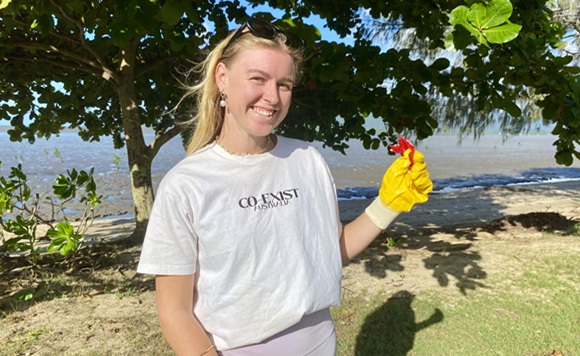
Co-exist Cairns: Next Generation of Coastal Carers
Co-exist Cairns is a new environmental (ad social) group for 18-30 year olds.

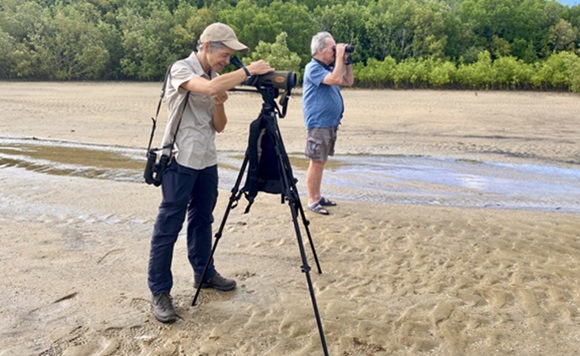
Cairns bird lover Sally Sheldon will never forget the first time she watched a mass roost of whimbrels – a type of migratory shorebird – at the mouth of the Barron River.
“Night was falling and over 600 of these birds were gathered together against the mangroves,” she says. “The sound they were making, constantly talking to each other, was deafening.
“They’d flown in on dusk from all points of the compass. At dawn we watched them quietly take off, one group after another. They were gone within minutes.”
Sally and another Cairns bird researcher, Paul Fisk, monitored whimbrels on the southern bank of the Barron River for four years, until 2023.
Paul discovered their nighttime roost in the 1990s – solving a mystery for local birders who’d long seen whimbrels leaving the Cairns Esplanade and mangrove areas from Yorkeys Knob to Yarrabah on dusk.
Whimbrels only huddle together in huge groups, it seems, at night.
“No other migratory shorebird that we know of roosts in such large numbers exclusively at night quite like that,” Sally, who works for Birdlife Australia, says.
“We would see 600 to 800 whimbrels together every night. Two or three decades ago, numbers were higher. Well over 1000 of these birds would come to Cairns. The Barron River seems to be a really important nighttime place for them, where they feel more protected.”
FAR AWAY FROM SHOOTERS
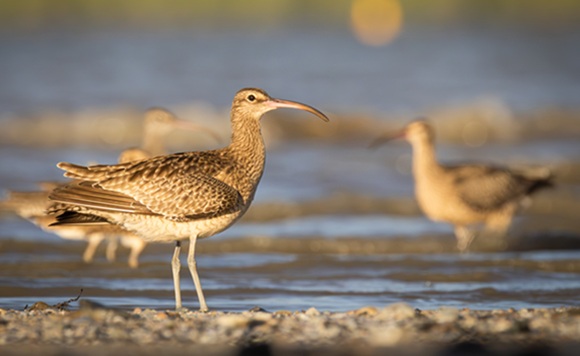
Whimbrels are still shot in large numbers in some parts of the world by recreational hunters and their feeding grounds are shrinking across the globe because of urban and industrial development.
Because of this, the Cairns mudflats and mangroves are becoming increasingly important for them – and about 25 other migratory shorebird species that travel huge distances to spend summer holidays here.
Up to 4000 shorebirds come to Cairns from Russia, Alaska, Mongolia and China each year after their breeding seasons. They spend up to seven months moulting, growing new feathers and, later in their stay, grazing almost non-stop on crabs, worms, shrimps and molluscs, to double their body weight for the long trip home.
Almost two thirds of these birds – 16 species – are listed as threatened.
A NATIONALLY SIGNIFICANT MIGRATORY SHOREBIRD LOCATION
“Cairns is a significant northern area for migratory birds in Australia,’’ Sally says.
“The Esplanade is one of their richest feeding areas. The inlet captures a mixture of fine sediment, creating extensive mangrove areas and intertidal mudflats with rich invertebrate life that you don’t see in many other places.
“It’s really important for these birds that we keep our mangrove estuaries and inter-tidal mudflats healthy.”
Very little is known about whimbrels when they’re in Australia and Sally puts that down to their nocturnal behaviour and their preference to “go solo” while hunting for food in the mangroves during the day.
“Most of the bird monitoring happens in the daytime when species roost together on high tide,’’ she says.
“We’d like to know more about whimbrels – from whether mass roosting at night is common in Australia to how many of the same birds we see each year.”
HOW WE CAN HELP
The best ways to help whimbrels and other migratory shorebirds is to preserve the natural environments they rely on, she says.
“With urban environments like the Cairns Esplanade, that can be a challenge. Even actions like sand replenishment work can affect their habitat because sand washes onto the mudflats and creates a barrier for feeding.
“Simple things we can all do to help are walking on the boardwalk, above the mudflats and the sandier sections of the Cairns Esplanade, and keeping dogs from chasing birds.”
ENDURANCE ATHLETES OF THE BIRD WORLD
Co-exist Cairns is a new environmental (ad social) group for 18-30 year olds.
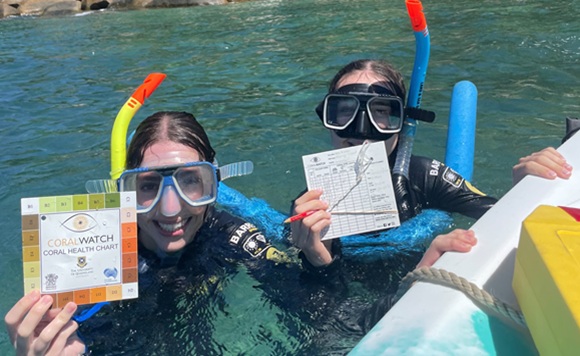
Co-exist Cairns is a new environmental (ad social) group for 18-30 year olds.
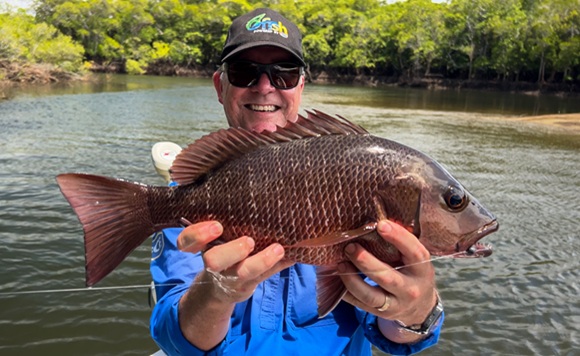
OzFish are restoring urban creeks in Cairns and discovering an amazing diversity of species.

Martine joined the Wet Tropics Waterways team as a Science Technical Officer in early 2024. She is an environmental scientist and ecologist and has worked on water quality and aquatic ecology projects as a consultant and in private industry for over 20 years. She is using her experience in statistical programming and database development to develop new systems for the Report Card.

Richard has been the Science Technical Officer for Wet Tropics Waterways since 2016. His role involves producing the annual results for the waterway health assessment of the wet tropics region using data from a wide range of sources, to present as scores and grades, as well as developing new indicators to address knowledge and monitoring gaps. He works in collaboration with technical staff at other regional report cards.
Richard has a background in freshwater ecology research projects and environmental assessments with CSIRO, University of Queensland, Queensland Government and as a consultant. For a long time he’s been interested in freshwater aquaculture and continues this interest through farming freshwater crayfish, alongside other farming activities.

Simon has over 30 years’ experience advocating for waterways across academia, government and the private sector. He started out in marine botany with a fascination for seagrass, mangroves and macroalgae, and has gone on to lead major environmental initiatives both in Australia and overseas. He has established report cards in eight countries.

Rowan is a conservation scientist with a background in wildlife science and tropical ecology. She holds a Bachelor of Wildlife Science from the University of Queensland and has recently completed a Master of Tropical Biology and Conservation at James Cook University.
Rowan brings experience in science communication, with a strong interest in connecting people with conservation outcomes. In her role with Wet Tropics Waterways, she supports initiatives that combine scientific knowledge with community outreach to help protect the Wet Tropics and Great Barrier Reef catchments, and to strengthen collaboration between researchers, stakeholders, and the wider community.