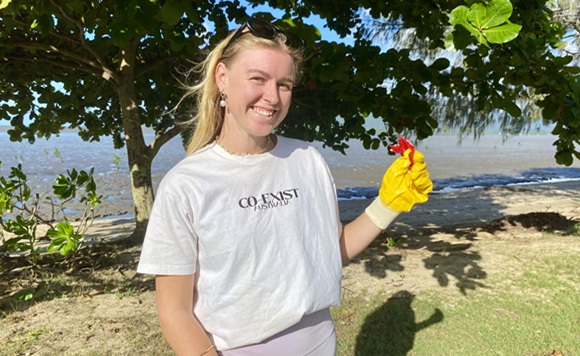
Co-exist Cairns: Next Generation of Coastal Carers
Co-exist Cairns is a new environmental (ad social) group for 18-30 year olds.

Do you remember your first dive on the Great Barrier Reef?
Yes, we went down and saw a pack of devil rays and lots of turtles. The sheer volume of coral cover, and how vibrant it was… it just hit you.
What’s your best experience underwater?
I’ve had a surreal one at Ribbon Reef No.2, taking photos in about seven metres of water. I heard a loud noise, like a train coming. It was a big school of giant trevallies. They made a tube around me and there were so many eyes on me. They did a couple of circles and then disappeared into thin air. Last November was another one. As far as the eye could see, the biggest humphead parrot fish were coming towards me. They can be over a metre long and they stand really high in the water. They’re listed as vulnerable but you’ll get big pockets of them sometimes.
What changes have you seen over the years?
After Cyclone Yasi, there was a lot of damaged coral at some reefs, down to about 25 metres. Gullies were scraped bare, there wasn’t even algae. And after Cyclone Larry, at places outside Myrmidon pinnacle you could see the wave pattern in the coral cover down to 20 metres. It comes back though. A year or two afterwards we saw new coral growth. Regrowth has been quite impressive.
How is managing crown-of-thorn starfish (COTS) helping the Reef?
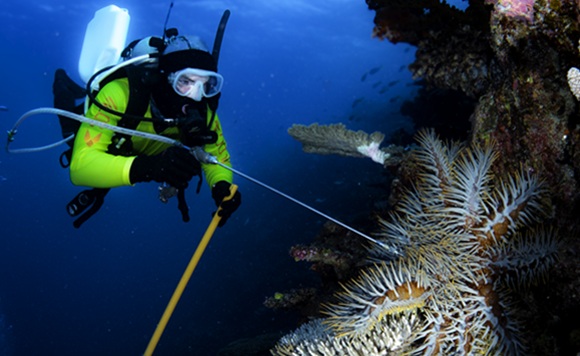
Crown-of-thorn starfish eat hard coral. They’re native to the Great Barrier Reef but can reach outbreak levels when they eat corals at a faster rate than it can grow, causing extensive coral mortality. COTS cycles can last 10 to 15 years. They’re a major threat to the Reef – but the threat that’s most responsive to direct management action. Every hard coral colony protected from COTS predation has a better chance to spawn, increasing the overall resilience of the Reef.
How do you control crown-of-thorn (COTS) starfish?
Trained COTS divers inject COTS with a single shot of bile salts or vinegar. The control program operates the length of the Reef. In the Cairns region, we focus on tourist reefs and high diversity reefs. Crews from tourist boats, control program partners and COTS divers are doing an amazing job.
Why should we care about corals?
The Great Barrier Reef has one of the highest diversities of coral on the planet. In some areas you’ll see meadows of soft coral, in others mountains of hard coral. If you think about how long they’ve been there… they’re like big old trees in the forest. Larger, older coral supports other coral species and the diversity creates amazing habitat for fish and many other species. Corals can bounce back quite quickly from adversity but with crown of thorns outbreaks, more marine heatwaves, coral bleaching events and more severe cyclones, there is less time for corals to recover.
What keeps you coming back for more?
The Great Barrier Reef is one of the most beautiful habitats on Earth. It’s mind-blowing. Every time you go out you find something to enjoy. The diversity is my passion. I’m always amazed by it.
Co-exist Cairns is a new environmental (ad social) group for 18-30 year olds.
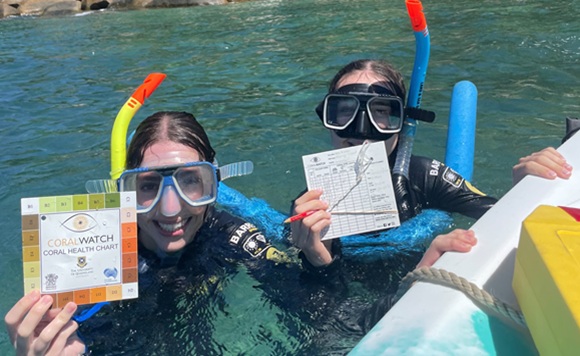
Co-exist Cairns is a new environmental (ad social) group for 18-30 year olds.
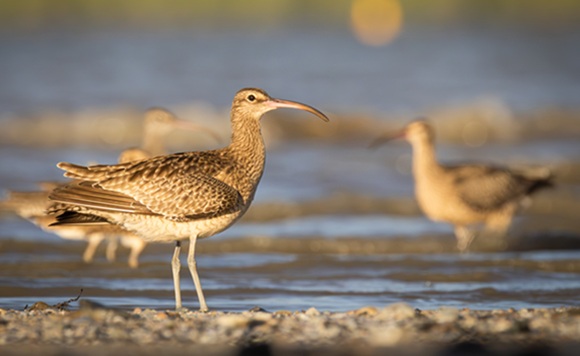
Whimbrels migrate thousands of miles to feed along the Cairns Esplanade each year.

Martine joined the Wet Tropics Waterways team as a Science Technical Officer in early 2024. She is an environmental scientist and ecologist and has worked on water quality and aquatic ecology projects as a consultant and in private industry for over 20 years. She is using her experience in statistical programming and database development to develop new systems for the Report Card.

Richard has been the Science Technical Officer for Wet Tropics Waterways since 2016. His role involves producing the annual results for the waterway health assessment of the wet tropics region using data from a wide range of sources, to present as scores and grades, as well as developing new indicators to address knowledge and monitoring gaps. He works in collaboration with technical staff at other regional report cards.
Richard has a background in freshwater ecology research projects and environmental assessments with CSIRO, University of Queensland, Queensland Government and as a consultant. For a long time he’s been interested in freshwater aquaculture and continues this interest through farming freshwater crayfish, alongside other farming activities.

Simon has over 30 years’ experience advocating for waterways across academia, government and the private sector. He started out in marine botany with a fascination for seagrass, mangroves and macroalgae, and has gone on to lead major environmental initiatives both in Australia and overseas. He has established report cards in eight countries.
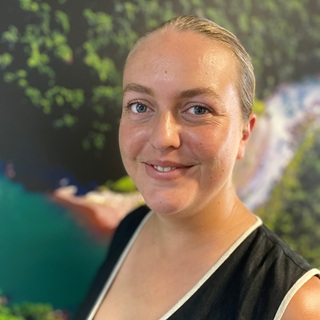
Rowan is a conservation scientist with a background in wildlife science and tropical ecology. She holds a Bachelor of Wildlife Science from the University of Queensland and has recently completed a Master of Tropical Biology and Conservation at James Cook University.
Rowan brings experience in science communication, with a strong interest in connecting people with conservation outcomes. In her role with Wet Tropics Waterways, she supports initiatives that combine scientific knowledge with community outreach to help protect the Wet Tropics and Great Barrier Reef catchments, and to strengthen collaboration between researchers, stakeholders, and the wider community.