50 years of protecting the reef.
Establishing the Great Barrier Reef Marine Park in 1975 was a game changer
Healthy waterways underpin our lifestyles and livelihoods. When waterways thrive, so do we.
Extreme flooding events are a part of living in the Wet Tropics, but even here floods are predicted to get worse with climate change. So what can we do to reduce the impacts and damage of floods on our landscapes, waterways and infrastructure?
Urban infrastructure in the Wet Tropics has been built on the principle of ‘hard and fast’. Drains and gutters are designed to remove water from the land as quickly as possible to prevent flooding. However, there is growing evidence that this won’t be effective in future with heavier rainfall and rising sea levels, so we need a paradigm shift. Rather than hard and fast, we need to work better with our natural systems and introduce softer infrastructure to help ‘slow it, spread it and soak it’.
A new project by Cairns Regional Council in the Saltwater Creek catchment is working with scientists at James Cook University to model the impacts of flooding under different climate scenarios and to identify and assess potential options for mitigation.
Lynne Powell, Coordinator of Sustainability and Climate Change at Cairns Regional Council, says installing flood mitigation solutions in urban areas involves a lot of risk. The modelling data from this project will help to understand how water behaves in the catchment and will be used when designing solutions.
“Saltwater Creek is a heavily urbanised catchment with a high flood risk,’’ she says. “Before we start planning for how we can mitigate flooding we need good evidence, which also includes Traditional Owner knowledge. One thing we’ve learned is that we need very localised solutions. We need to plan right down to individual sub-catchment level and use a range of different solutions tailored to each area and layered on top of each other. There is no one-size-fits-all solution.”
James Cook University hydrology researcher Dr Han She Lim says the modelling will assess design solutions for households, businesses and schools, as well as for the council. Some potential solutions include green roofs and walls, rainwater tanks, bioretention basins, vegetated drains and landscape planter boxes, all of which are designed to intercept stormwater runoff.
“The designs that we come up with need to be tailored to local catchments and engineered for our climate conditions,’’ she says. “Many of these solutions are already being adopted in other Australian cities but we will need to engineer the designs to suit our tropical climate. For example, to prevent mosquitoes breeding we need to modify designs to hold water only for a maximum of one to two days.
“One of the outcomes of this project will be to develop design guidelines for our region. Hopefully they will be useful for other tropical areas too since Cairns has the potential to be a good model city for others.”
Dr Lisa Law, an urban geography and planning researcher at James Cook University, says there’s a lot more we can do to improve the sustainability of our urban areas, and we need more ‘water-sensitive design solutions’.
“Ideally our urban areas should include lower-density neighbourhoods with lots of green spaces and trees as well as targeted engineered solutions,’’ she says. “While we can do this easily with new developments, retro-fitting older suburbs is much more challenging, so we will need to be innovative.
“Changing from hard and fast to soft infrastructure requires a paradigm shift, particularly because it will involve more maintenance. But the benefits for future liveability, flood mitigation and water quality flowing to the reef make it a no-brainer.”

Establishing the Great Barrier Reef Marine Park in 1975 was a game changer

150 cane farmers are participating in a project to boost productivity and water quality

Read about some of our region's rare and unusual native fish species

Martine joined the Wet Tropics Waterways team as a Science Technical Officer in early 2024. She is an environmental scientist and ecologist and has worked on water quality and aquatic ecology projects as a consultant and in private industry for over 20 years. She is using her experience in statistical programming and database development to develop new systems for the Report Card.

Richard has been the Science Technical Officer for Wet Tropics Waterways since 2016. His role involves producing the annual results for the waterway health assessment of the wet tropics region using data from a wide range of sources, to present as scores and grades, as well as developing new indicators to address knowledge and monitoring gaps. He works in collaboration with technical staff at other regional report cards.
Richard has a background in freshwater ecology research projects and environmental assessments with CSIRO, University of Queensland, Queensland Government and as a consultant. For a long time he’s been interested in freshwater aquaculture and continues this interest through farming freshwater crayfish, alongside other farming activities.
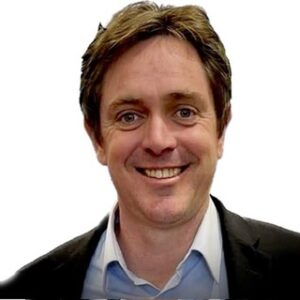
Simon has over 30 years’ experience advocating for waterways across academia, government and the private sector. He started out in marine botany with a fascination for seagrass, mangroves and macroalgae, and has gone on to lead major environmental initiatives both in Australia and overseas. He has established report cards in eight countries.
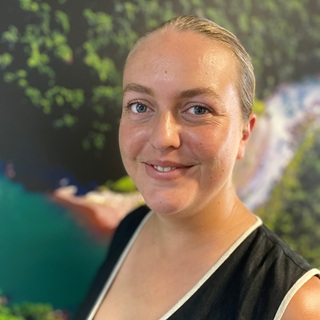
Rowan is a conservation scientist with a background in wildlife science and tropical ecology. She holds a Bachelor of Wildlife Science from the University of Queensland and has recently completed a Master of Tropical Biology and Conservation at James Cook University.
Rowan brings experience in science communication, with a strong interest in connecting people with conservation outcomes. In her role with Wet Tropics Waterways, she supports initiatives that combine scientific knowledge with community outreach to help protect the Wet Tropics and Great Barrier Reef catchments, and to strengthen collaboration between researchers, stakeholders, and the wider community.