50 years of protecting the reef.
Establishing the Great Barrier Reef Marine Park in 1975 was a game changer
Healthy waterways underpin our lifestyles and livelihoods. When waterways thrive, so do we.
Less than 2% of waste plastic is currently recovered in Far North Queensland, compared to 5.7 % across Queensland and 9.5 % nationally. The remainder goes to landfill, so we’ve got plenty of room to improve.
Some good news is that there is a growing appetite for a commercial plastics hub in Far North Queensland, which would see our plastic waste being re-manufactured locally rather than trucked to Brisbane and then brought back as a new product.
A feasibility study by the RPS Group for Regional Development Australia Tropical North shows that a plastics hub would annually divert 5400 tonnes of plastic from landfill, reduce emissions of C02 by 5000 tonnes, and bump up our recovery rate to 17%. The hub would create 83 full-time jobs during construction and six full-time jobs once it was up and running. As part of the study, a feasibility template is available and replicable by other regions that are facing similar challenges.
Half of the plastic items we buy are used once and thrown away. A lot of plastic becomes litter which is washed into our waterways. It causes harm when animals get tangled in or injured by litter, or mistake it for food. Plastics break up into smaller and smaller pieces and absorb toxic industrial chemicals which, when ingested by animals are absorbed into their tissues. Some microplastics are so small that we actually breathe them in—these are called nano or pico plastics.
It’s hard to know yet exactly what implication this has for humans. What we do know from studying other species is that contaminants from plastics can change their hormone levels and endocrine systems.
Plastic free doesn’t mean waste free. Reusable products are the best alternative to single-use disposable products, so BYO cups, cutlery, bottles and containers or join a reusable café cup program like Green Caffeen.
Some alternatives are better than others. Encourage businesses and food vendors to use alternative products that have the least impact on the environment, like 100 per cent home compostable products that are certified under Australian standards.
Stop extra plastic going to landfill with these easy actions:
Great news for our waterways and our region! From the 1 September 2021, the supply of some types of single-use plastic is banned in Queensland.
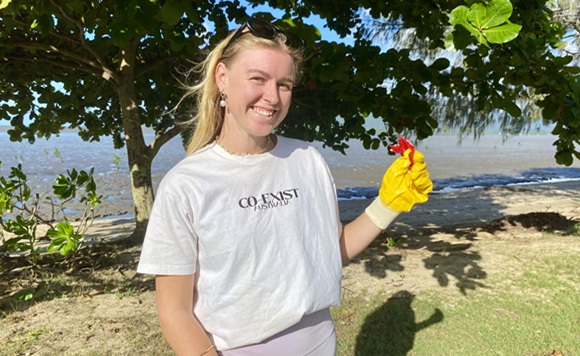
Last year there were 162 beach and waterway clean ups around the region. Almost 1000 volunteers were involved, and over seven tonnes of debris was removed. The most littered items were plastic remnants, plastic packaging items and plastic consumer items. With the ban now in effect, we hope to see far less single-use plastic items trashing the environment.
Additional single-use plastic items may be banned in the future, after further consultation. If you are a food or drink retailer in the Cairns or Port Douglas area you can access free, personalised support from Plastic Free Cairns. For those outside those areas, handy general resources are available at plasticfreecairns.org

Establishing the Great Barrier Reef Marine Park in 1975 was a game changer

150 cane farmers are participating in a project to boost productivity and water quality

Read about some of our region's rare and unusual native fish species

Martine joined the Wet Tropics Waterways team as a Science Technical Officer in early 2024. She is an environmental scientist and ecologist and has worked on water quality and aquatic ecology projects as a consultant and in private industry for over 20 years. She is using her experience in statistical programming and database development to develop new systems for the Report Card.

Richard has been the Science Technical Officer for Wet Tropics Waterways since 2016. His role involves producing the annual results for the waterway health assessment of the wet tropics region using data from a wide range of sources, to present as scores and grades, as well as developing new indicators to address knowledge and monitoring gaps. He works in collaboration with technical staff at other regional report cards.
Richard has a background in freshwater ecology research projects and environmental assessments with CSIRO, University of Queensland, Queensland Government and as a consultant. For a long time he’s been interested in freshwater aquaculture and continues this interest through farming freshwater crayfish, alongside other farming activities.
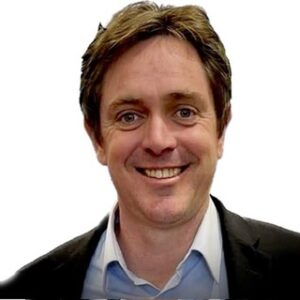
Simon has over 30 years’ experience advocating for waterways across academia, government and the private sector. He started out in marine botany with a fascination for seagrass, mangroves and macroalgae, and has gone on to lead major environmental initiatives both in Australia and overseas. He has established report cards in eight countries.
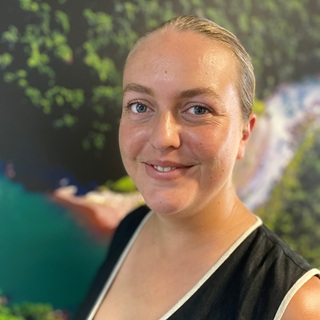
Rowan is a conservation scientist with a background in wildlife science and tropical ecology. She holds a Bachelor of Wildlife Science from the University of Queensland and has recently completed a Master of Tropical Biology and Conservation at James Cook University.
Rowan brings experience in science communication, with a strong interest in connecting people with conservation outcomes. In her role with Wet Tropics Waterways, she supports initiatives that combine scientific knowledge with community outreach to help protect the Wet Tropics and Great Barrier Reef catchments, and to strengthen collaboration between researchers, stakeholders, and the wider community.