For the first time, the annual Wet Tropics Waterway Health Report Card includes data on mangrove condition. Wet Tropics Waterways Chair Dr. Greg Vinall said the Daintree River, with minimal surrounding development, scored the highest for mangrove condition and was graded in ‘very good’ condition while Trinity Inlet scored the lowest but was still considered in ‘good’ condition.
Dr. Vinall said mangroves were an essential part of our coastal ecosystems.
“Mangroves provide a nursery for fish, act as a buffer for coastal communities from cyclones, storm surges and flooding, and act as a filter for water running off the land,” he said.
“The Wet Tropics has the greatest diversity of mangroves in Australia but they are under threat from climate change as well as local pressures such as urban development, rubbish, pollution and weeds.”
Data for the report card’s new mangrove assessment is gathered by the Cairns and Far North Environment Centre’s (CAFNEC) MangroveWatch program with help from volunteer citizen scientists.
Project Coordinator Alex Sinchak said the citizen scientists had been monitoring Trinity Inlet and the Barron River since 2017, and Dickson Inlet, the Mulgrave and Russell Rivers since 2019.
“More than 400 volunteers, Landcare group members, and Indigenous rangers have been trained to collect data for the program since the Far Northern chapter of MangroveWatch began,” she said. “Participants use a science-based methodology to conduct land-based saltmarsh monitoring, and also head out in boats to take video, photographs and observer notes to record geotagged visual data of mangrove shorelines.”
“This program demonstrates the power of citizen science; the data has filled an important knowledge gap and it’s great that it is now being used as another indicator of waterway health. Soon we’ll be rolling the program out across the remaining four estuaries in the Wet Tropics.”
Mangroves are garnering increased attention world-wide as more research into their ‘blue carbon’ potential is conducted.
“Mangroves are among the most efficient ecosystems in the world at sequestering and storing carbon, and we must look after them,” Ms. Sinchak said. “Our monitoring identifies the health of the mangrove, and present threats in the ecosystem, which informs us on how best to help them. We can use this information to inform local stewardship and then lobby for investment in targeted rehabilitation and management.”
The 2022 report card assesses the region’s nine catchments and eight estuaries, as well as the inshore marine and offshore marine zones, by analysing and integrating scientific monitoring data contributed by a number of organisations.
It is produced annually by Wet Tropics Waterways as an initiative of the Reef 2050 Plan, an Australian and Queensland Government framework for protecting and managing the quality of water flowing to the Great Barrier Reef lagoon.
The latest report card reveals that most freshwater rivers and estuaries from the Daintree to Ingham’s Herbert River continue to be in ‘good’ or ‘very good’ condition.
This year’s report card also includes an updated assessment of fish barriers across the region.
Dr Vinall said many fish species in the Wet Tropics need to migrate between freshwater and estuary habitats to complete their life cycle but fish barriers as small as road crossings and culverts, can restrict the movement of juvenile fish to upstream habitat that is critical for their survival.
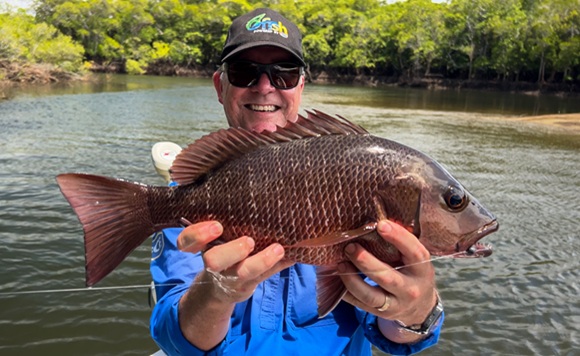
“Several projects around the region are focused on remediating priority barriers,” he said. “Improving connectivity of fish habitats is good news for some of our most iconic species such as mangrove jack and barramundi.
“The most significant fish barrier added in the 2020-21 assessment was a rock weir on the lower Herbert River. The water level drops enough to create a barrier in the late wet and through the dry season, and cuts off 250km of potential upstream habitat.”
Today’s release of the Wet Tropics Waterway Health Report Card coincides with the second edition of Wet Tropics Waterways’ environment and lifestyle magazine, Reef & Rivers. The magazine celebrates our waterways and highlights the work of many people around our region to improve waterway health.
Minister for the Environment and the Great Barrier Reef Meaghan Scanlon acknowledged the efforts of everyone involved in producing this year’s report card.
“This year’s grades are the collaborative result of governments, industry and community groups working together to improve the health of our local waterways,” Ms Scanlon said.
“The Queensland Government is contributing $1.25 million this year to support the five Great Barrier Reef regional report card partnership programs.
“This funding will be used to support report card data collection, stewardship activities and community education programs that will benefit the environment and help to protect the Reef.”
The Wet Tropics Partnership is supported by the Queensland, Australian and local governments, industry, community and other partners, including the host of the partnership, Terrain.
Learn more about the Wet Tropics Waterway Health Report Card results, and methods used to generate the grades.