
Indigenous Ranger groups: Leading on Country
Ranger groups are expanding and building capacity across the region

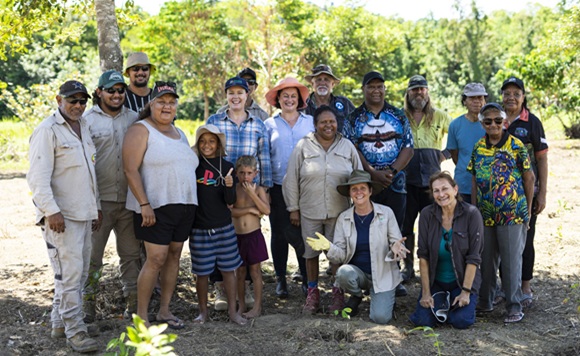
Franco and Frances Arri once grew some of the closest sugar cane crops to the Great Barrier Reef – on land less than three kilometres from the ocean.
In the last of the Wet Tropics region’s sugar expansions, they bought a cane farm at Deeral and upgraded the drainage systems to make low-lying land productive.
Their farm produced 95,000 tonnes of sugar cane in 43 years. Now its low-lying areas are being returned to a natural wetland – something that has long been a ‘bucket-list’ item for them.
Franco and Frances are working with Greening Australia, Madjandji Aboriginal Corporation’s Madjaybana Rangers and Mulgrave Landcare to plant mangroves and trees along their cane drains, and they are loving the results.
“We started planting around the drains about three years ago,’’ Franco says. “Over 15,000 trees are in the strips of trees along the waterways now. It’s great. The revegetation has happened so fast on these soils.
“We are close to the ocean, and our eastern boundary abuts the Mulgrave River. We were always conscious of that in our farming practices. And these days it’s less about what the land can do for us and more about what we can do for the river, the Reef…”
The latest tree-planting was part of the Queensland Government’s Reef Assist program – a $34 million initiative to improve the health of river catchments adjacent to the Great Barrier Reef while also creating ‘green jobs’ and training opportunities.
In Far North Queensland more than 160,000 native plants have been planted along waterways through the program.
Greening Australia’s Lisa O’Mara says the projects she has been involved in are some of the best she’s experienced in many years of land care.
“The community has been right behind us,’’ she says. “One year in, Cyclone Jasper came along and a third of the trees we’d planted were lost.
“We all got back out there and replanted. The end result is 8.5 hectares of revegetation along waterways that’s brought so many people together.”
Mulgrave Landcare’s nursery in Gordonvale has expanded under the Reef Assist program. Staff and volunteers provided seedlings for the project and joined forces with Madjaybana rangers to build up seedling stock and host combined community tree plantings.
“The expansion of the nursery has been wonderful for Mulgrave Landcare,” Belinda Billing says. “We now have a community nursery with volunteers coming together two mornings a week, producing thousands of seedlings for revegetation projects each year.
“Landcare is about conservation and community, and the nursery supports both.”
Madjaybana Senior Ranger Anthony Satini says the ranger group grew from six to 10 during the project, and blended traditional knowledge with training covering everything from ecosystem management to vegetation surveys, water quality monitoring and drone operation.
He says watching low-lying land return to its original state has been the most satisfying part.
“We began in some places in thick guinea grass, wild raspberry, calopo vine… To see the change from that to what we have now has been a big highlight. Some of the trees are up to six metres high now.”
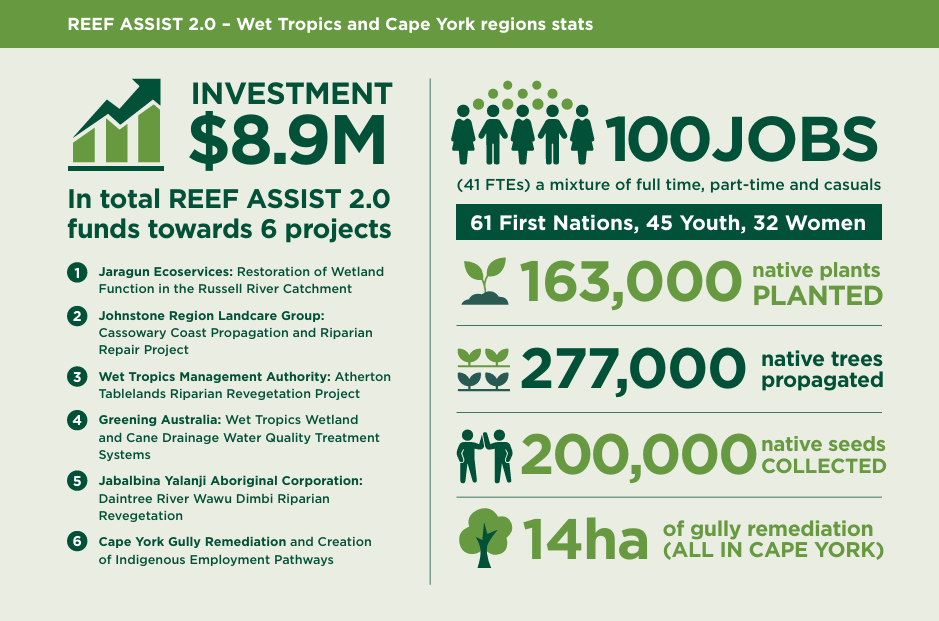
Five projects were undertaken and completed between 2023 and 2026 in the Wet Tropics under the Reef Assist program. The Reef Assist program is funded through the Queensland Government’s Queensland Reef Water Quality Program.
Ranger groups are expanding and building capacity across the region
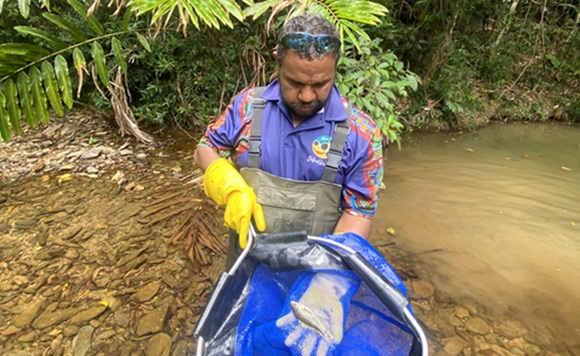
Scientists are in a race to save one of Australia's rarest freshwater fish species
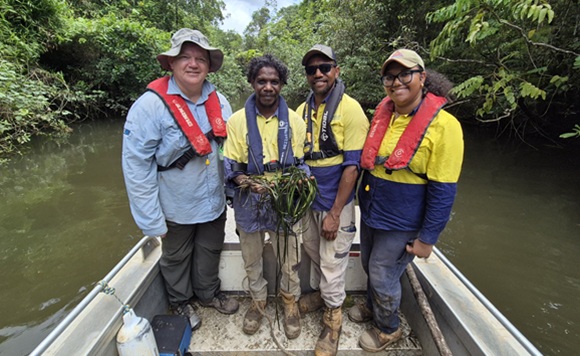
Scientists and rangers are working together to restore native eel grass in the Russell

Martine joined the Wet Tropics Waterways team as a Science Technical Officer in early 2024. She is an environmental scientist and ecologist and has worked on water quality and aquatic ecology projects as a consultant and in private industry for over 20 years. She is using her experience in statistical programming and database development to develop new systems for the Report Card.

Richard has been the Science Technical Officer for Wet Tropics Waterways since 2016. His role involves producing the annual results for the waterway health assessment of the wet tropics region using data from a wide range of sources, to present as scores and grades, as well as developing new indicators to address knowledge and monitoring gaps. He works in collaboration with technical staff at other regional report cards.
Richard has a background in freshwater ecology research projects and environmental assessments with CSIRO, University of Queensland, Queensland Government and as a consultant. For a long time he’s been interested in freshwater aquaculture and continues this interest through farming freshwater crayfish, alongside other farming activities.

Simon has over 30 years’ experience advocating for waterways across academia, government and the private sector. He started out in marine botany with a fascination for seagrass, mangroves and macroalgae, and has gone on to lead major environmental initiatives both in Australia and overseas. He has established report cards in eight countries.
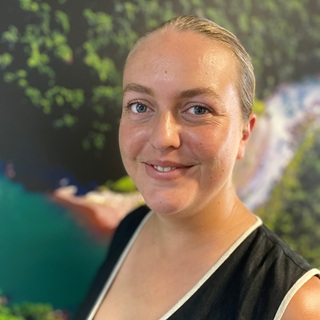
Rowan is a conservation scientist with a background in wildlife science and tropical ecology. She holds a Bachelor of Wildlife Science from the University of Queensland and has recently completed a Master of Tropical Biology and Conservation at James Cook University.
Rowan brings experience in science communication, with a strong interest in connecting people with conservation outcomes. In her role with Wet Tropics Waterways, she supports initiatives that combine scientific knowledge with community outreach to help protect the Wet Tropics and Great Barrier Reef catchments, and to strengthen collaboration between researchers, stakeholders, and the wider community.