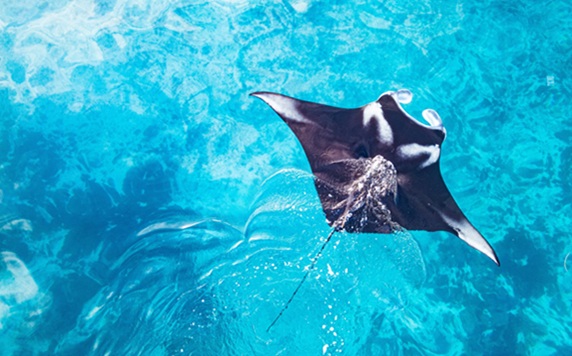
When a manta ray was tagged off the Frankland Islands last year, it took scientists, traditional owners and the general public on an unexpected voyage.
‘Yulu’ the manta ray travelled 340 kilometres in two weeks, heading north from the Frankland Islands and reaching waters just south of Cooktown. Then her tag came off and she was lost to online viewers.
Her trip, swimming at about one kilometre an hour, was keenly watched by the Gunggandji-Mandingalbay Yidinji Land and Sea Rangers and by scientists at Biopixel Oceans Foundation.
“We know very little about manta rays on the northern Great Barrier Reef, which reduces our ability to protect them,’’ Biopixel’s Ingo Miller says.
The Biopixel team has tagged 11 reef manta rays over the last nine years, two of them at reefs off the Wet Tropics region and the rest in the Weipa-Aurukun area and south to Bowen.
The Frankland Islands, off Deeral, is a known group feeding site while further north, at Ribbon Reef off Cooktown, there are several known manta ray cleaning stations.
Manta rays could be described as ‘clean freaks’ – they make pitstops for smaller fish to remove dead skin and parasites, and they’ve been recorded returning to the same spot again and again and happily spending up to an hour on the cleaning process.
Osprey Reef, off Cairns, is another known location for groups of manta rays.
“Most of our knowledge about them up here is through tourism operators and other boaties,” Ingo says. “We tag to fill knowledge gaps but it’s a challenge because they’re not the easiest species to locate or tag.”
“Unlike sharks, we don’t usually catch and release manta rays. We swim with them and they’re powerful swimmers that don’t usually approach you or stay close by. We need to be 100 per cent sure when we shoot, so the tag goes into the right spot.”
Other manta rays have been monitored by satellite on the Great Barrier Reef for up to six months, some travelling more than 1,500 kilometres within a 200km radius.
Gunggandji-Mandingalbay Yidinji Traditional Owners are hopeful more tagging will happen in the Frankland Island area to build up knowledge.
They’ve been working with Biopixel Ocean Foundations to tag wildlife as part of research into seagrass and its role in the food chain, and they’re training so that this kind of monitoring work can continue after the project ends.
Land and Sea Ranger Brody Gray says it has been an eye-opener.
“You see things like shark tagging on television – and now we’re getting to go out and learn exactly how it’s done. We already monitor large animals but the science side of things is really interesting.
“The tagging is one way – along with recording sightings and working with scientists sampling invertebrates like crabs and prawns, and smaller fish species – to learn more about which species are part of the seagrass food web.
“It also tells us where different species are feeding. Combining science and cultural ways brings more results. And the more we know, the better we can look after the health of the Reef.”
GETTING TO KNOW MANTA RAYS
- They have the largest brain to body ratio of any fish.
- The reef manta rays’ wingspan can reach 5.5 metres. Giant manta rays get to 7 metres.
- ‘Manta’ comes from the Spanish word for blanket.
- They are gentle giants, with no tail spine.
- They are highly coordinated, doing barrel rolls and swimming in circles to catch food, including small fish, in their wake.
- They can live for up to 50 years but they’re not big reproducers.
- They are listed as a vulnerable species.
- Threats include fishing, habitat degradation, poor water quality and sea temperature rises.
Share your manta ray photos and videos with Project Manta, a research project run by Sunshine Coast University. Email projectmanta@usc.edu.au
Through GMYPPBC RNTBC, the Gunggandji–Mandingalbay Yidinji Rangers partnered with Biopixel Oceans Foundation and JCU TropWATER to deliver the Stable Isotope Seagrass and Megafauna Project, supported and funded by the Reef Trust Partnership, a collaboration between the Australian Government and the Great Barrier Reef Foundation.
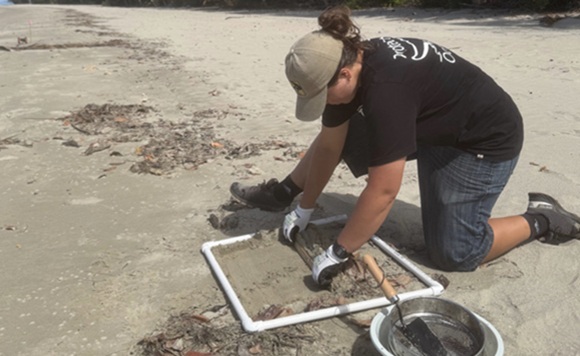
Microplastics: Tiny Plastics, Big Problem
Contamination levels are low in the Wet Tropics but we need to stay vigilant
Turning the Tide on Erosion
Graziers on the Tablelands are doing their bit to reduce sediment runoff