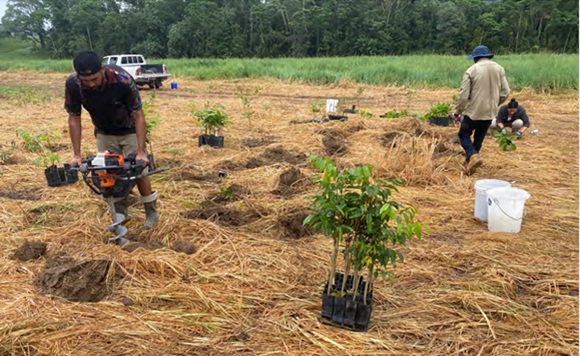
Reef Assist 2.0: Planting seeds and opportunities.
Community groups are restoring riverbanks to help filter water runoff


Most of us think of platypus when we think of Peterson Creek at Yungaburra. It’s definitely a place to go if you want to spot these reclusive creatures, known as ‘Ngunba’ in the local Dulgubarra Yidinji language, whose populations are declining across much of eastern Australia.
The Yungaburra platypus crew lives in burrows on the edge of a creek that Landcare volunteers and the Dulgubarra Yidinji clan have spent years transforming from a weed-choked waterway into a wildlife haven.
Together, they’re now going one step further, working on a new project that’s monitoring both platypus and the quality of water in Peterson Creek, a 9km waterway that passes through farmland and Yungaburra before flowing into Lake Tinaroo and, ultimately, the Barron River.
Volunteers are taking water samples every three weeks near the creek’s rainforest source and at a platypus viewing spot near town. They are also using a motion-activated video camera to better understand platypus activities, and this will work in with a new James Cook University research project using environmental DNA, citizen science records and biological samples to learn more about the platypus population.
Yungaburra Landcare Group’s Dermot Smyth says footage of a female platypus has been a highlight.
“We saw a mother climbing a five-metre embankment dragging wet vegetation with her tail and hind feet so she could line the burrow for youngsters.
“We’ve got nighttime footage of her coming and going throughout breeding season and the camera has also captured other species including tree kangaroos, possums, rakali, snakes, water dragons and birds.
“It’s nice to see to how vegetating even a narrow strip beside the creek has brought in so many native species.”
The water testing part of the project is happening over a wet and dry season. Samples are analysed at the Cairns Regional Council laboratory for everything from bacteria, nutrients and suspended solids to electrical conductivity and pH levels.
“This is the first time the difference in water quality between the creek’s source and further downstream is being measured. Early results show much higher sediment loads downstream.
“We will be sharing the final results along with a draft strategic plan for managing Peterson Creek, taking into account Traditional Owners, landowners, tourists, the council and other stakeholders. With more information we are hoping that we can all do better.”
Yungaburra Landcare Group has a community grant from Landcare Australia for this project.
Community groups are restoring riverbanks to help filter water runoff

Littoral rainforest is a threatened ecological community along our coastlines

Martine joined the Wet Tropics Waterways team as a Science Technical Officer in early 2024. She is an environmental scientist and ecologist and has worked on water quality and aquatic ecology projects as a consultant and in private industry for over 20 years. She is using her experience in statistical programming and database development to develop new systems for the Report Card.

Richard has been the Science Technical Officer for Wet Tropics Waterways since 2016. His role involves producing the annual results for the waterway health assessment of the wet tropics region using data from a wide range of sources, to present as scores and grades, as well as developing new indicators to address knowledge and monitoring gaps. He works in collaboration with technical staff at other regional report cards.
Richard has a background in freshwater ecology research projects and environmental assessments with CSIRO, University of Queensland, Queensland Government and as a consultant. For a long time he’s been interested in freshwater aquaculture and continues this interest through farming freshwater crayfish, alongside other farming activities.
Simon has over 30 years’ experience advocating for waterways across academia, government and the private sector. He started out in marine botany with a fascination for seagrass, mangroves and macroalgae, and has gone on to lead major environmental initiatives both in Australia and overseas. He has established report cards in eight countries.
Louise joined Wet Tropics Waterways as Executive Officer in 2025.
Louise Hateley is an environmental scientist with over 20 years of experience in natural resource management, water quality, and catchment modelling across government, research, and community sectors. She has held senior scientific and project coordination roles with the Department of Natural Resources, Mines and Energy and Terrain NRM, leading projects focused on GBR catchment health, waterway management, and sustainable land use. With a record of published research, stakeholder engagement, and project delivery, Louise combines scientific expertise with practical leadership to drive initiatives that protect the Wet Tropics and support community collaboration.