Turning the Tide on Erosion
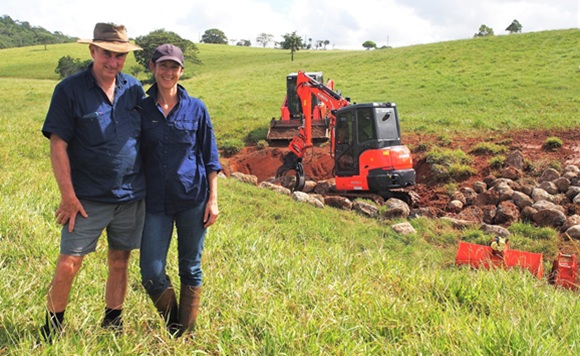
Graziers on the Tablelands are doing their bit to reduce sediment runoff

It’s a sunny morning on the Russell River and the water clarity is amazing – so it’s easy to see a huge patch of Vallisneria nana, a native eel grass, growing on the riverbed.
It’s also exciting. Eleven years ago, this patch was tiny and a one-off reminder of what the waterway might have looked like before glush weed – a plant introduced into Australia for aquariums – took over large stretches of the river.
Now this patch is a fish haven. And it’s also the basis for establishing other areas of Vallisneria in the Russell River, thanks to an ambitious transplanting project that began a year and a half ago.
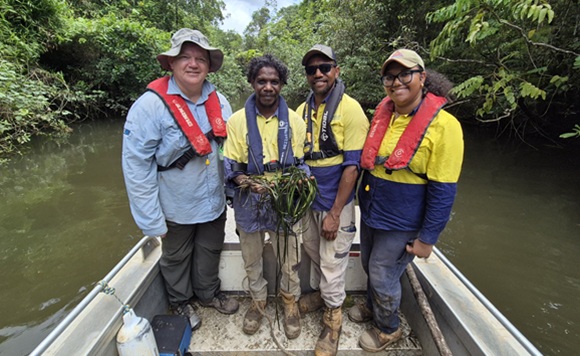
Jaragun Ecoservices’ rangers have been working with scientists from James Cook University to restore the river’s natural habitat.
“First we needed to do a lot of weed control,’’ Jaragun’s Talia Beaut says. “Jaragun has been removing glush weed for 10 years, and also planting native trees to stabilise the riverbank.”
Vallisneria samples were initially placed in tanks in a laboratory to trial transplanting methods.
“Results showed we should be able to tie (metal) nuts to the plants and drop them from the boat to do the transplanting,’’ Talia says. “Now we are trialling the best kinds of sites – from how much sunlight to substrates, water flow and different water depths.
“We think fish might be nibbling plants before they’ve had a chance to establish, so we’re running a trial to see if that’s the case.”
Rangers are also testing the river’s water quality on a regular basis, looking at everything from nutrient and salinity levels to temperature changes, to start long-term records that’ll help with eel grass monitoring and also the river’s overall health.
James Cook University Associate Professor Nathan Waltham says seeing phenomenal growth at a trial site one year after the first transplants was “super exciting”.
“Two beds are quite extensive. We’ve had some success, and transplants are progressively getting better. The goal is to keep moving into new sites in the river.
“At the start of this project, there were three natural beds. One has eroded since, which highlights the dynamic nature of these systems, and the need for urgent restoration action.”
Jaragun EcoServices is hoping this will prove to be a cost-effective, scalable way to bring the species back in Wet Tropics river systems and others across Australia.
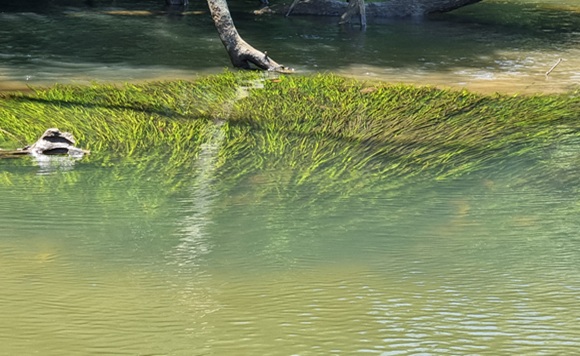
Vallisneria beds are important for many reasons – they become nursery areas for fish, they protect smaller fish species and they serve as a food source. The grasses also filter water, capturing fine sediment that’s moving downstream. They stabilise the riverbed and, like seagrass along the coast, they store carbon from the atmosphere.
Jaragun EcoServices has partnered with Griffith University on soil carbon assessments in the Russell River and with James Cook University on the carbon values of laboratory-grown Vallisneria – and Traditional Owners are hopeful the native grass can be part of broader ‘teal’ carbon initiatives in the future involving the removal of glush weed.
Ranger Robert Ambrum says watching fast growth rates of Vallisneria has been rewarding.
“Going through the whole process – from collecting the plants and trimming them up to choosing new sites and trying to establish this species – it makes the growth rates even better to see.
“In the river, these plants are growing centimetres every few days.”
“And we are seeing eels, catfish, barramundi, freshwater mussels…”
He describes glush weed as “the guinea grass of waterways”.
The escaped aquarium plant can form thick mats and outcompete native plants like Vallisneria in the water, while also taking over on the land. The weed’s denseness means that fish life suffers as well, and its sticky seeds can spread via boats and wildlife.
“Vallisneria and glush weed like the same conditions,” Robert says. “We still have glush weed in one area of the river and we’re on the lookout for outbreaks.”
“Our goal is to find areas upstream that can act as nursery beds for Vallisneria, so we have plant material on an ongoing basis.”
The ‘Restoration of Multihabitat Mangrove Ecosystems – Russell-Mulgrave Basin’ project is funded by the Australian Government’s Reef Trust. Jaragun EcoServices is working in partnership with James Cook University and Griffith University.
Graziers on the Tablelands are doing their bit to reduce sediment runoff
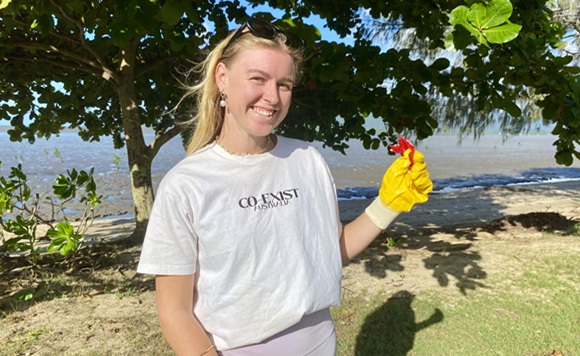
Co-exist Cairns is a new environmental (ad social) group for 18-30 year olds.
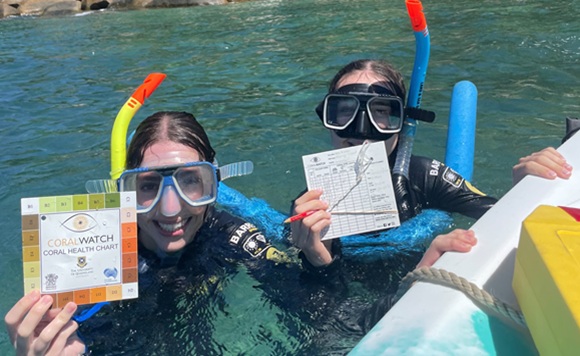
Co-exist Cairns is a new environmental (ad social) group for 18-30 year olds.

Martine joined the Wet Tropics Waterways team as a Science Technical Officer in early 2024. She is an environmental scientist and ecologist and has worked on water quality and aquatic ecology projects as a consultant and in private industry for over 20 years. She is using her experience in statistical programming and database development to develop new systems for the Report Card.

Richard has been the Science Technical Officer for Wet Tropics Waterways since 2016. His role involves producing the annual results for the waterway health assessment of the wet tropics region using data from a wide range of sources, to present as scores and grades, as well as developing new indicators to address knowledge and monitoring gaps. He works in collaboration with technical staff at other regional report cards.
Richard has a background in freshwater ecology research projects and environmental assessments with CSIRO, University of Queensland, Queensland Government and as a consultant. For a long time he’s been interested in freshwater aquaculture and continues this interest through farming freshwater crayfish, alongside other farming activities.

Simon has over 30 years’ experience advocating for waterways across academia, government and the private sector. He started out in marine botany with a fascination for seagrass, mangroves and macroalgae, and has gone on to lead major environmental initiatives both in Australia and overseas. He has established report cards in eight countries.
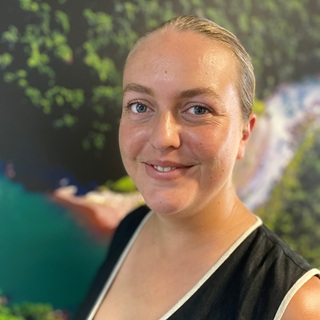
Rowan is a conservation scientist with a background in wildlife science and tropical ecology. She holds a Bachelor of Wildlife Science from the University of Queensland and has recently completed a Master of Tropical Biology and Conservation at James Cook University.
Rowan brings experience in science communication, with a strong interest in connecting people with conservation outcomes. In her role with Wet Tropics Waterways, she supports initiatives that combine scientific knowledge with community outreach to help protect the Wet Tropics and Great Barrier Reef catchments, and to strengthen collaboration between researchers, stakeholders, and the wider community.