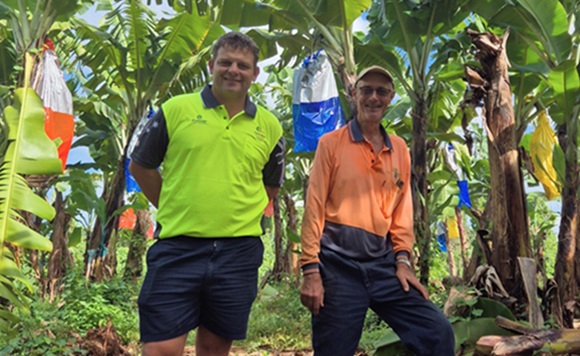
ABC Bananas: Farming for the future.
Banana farmers making land management changes to improve water quality to the Reef


We need to go beyond farm-based changes. And that means scaling up broad landscape repair work, including restoring wetlands and installing engineered water treatment systems to intercept runoff before it reaches waterways.
Wetlands as pollutant removers
Researchers have been monitoring several wetlands, including three constructed wetlands in the Wet Tropics – on cane, banana and cattle farms. The concentrations of nitrogen and sediment going into and out of the wetlands show they are working effectively to clean pollutants from runoff and further data has been collected to estimate the quantities removed.
Tony Weber from Alluvium Consulting says the data collected from these wetlands is being used to test a model that predicts how wetlands will perform under different weather and landscape conditions. The model can calculate the overall water quality improvement if wetlands were repeated across the landscape, making it useful for planning and managing future wetlands to improve the quality of water flowing to the Reef.
“It takes time and a lot of data to understand how wetlands function,” he says. “But what we’ve learned is clear—vegetation is everything. With the right amount of vegetation and proper maintenance, wetlands can effectively remove a lot of nutrients.”
Water flow also matters. Tony says wetlands need to hold water long enough for pollutants to be removed and if water flows through too quickly, they don’t work as effectively.
The Road Ahead
Wetlands are an important part of the broader Reef ecosystem. Evidence shows that the negative impacts of pollutants running off the land to the Reef can be reduced by installing treatment wetlands in addition to expanding the restoration of natural wetlands, particularly on land with low agricultural value.
James Donaldson, former Executive Officer at Wet Tropics Waterways, says the goal is to reduce pollutants at the source through good farm practices, and then to use treatment wetlands as interceptors that clean up any runoff before it enters waterways. Natural wetlands can provide the final ‘polish’.
“Wetlands are important to our aquatic landscapes—they protect our rivers, lakes and the Reef lagoon from pollutants and provide vital habitat for birds, fish, reptiles and amphibians. They also provide a buffer against storms and floods.
“We need to protect the wetlands we have and bring degraded ones back to life.”
Fast Facts
The wetland monitoring is a collaboration between Terrain NRM, James Cook University, Griffith University and Queensland Government agencies. It is funded by the partnership between the Australian Government’s Reef Trust and the Great Barrier Reef Foundation.
Banana farmers making land management changes to improve water quality to the Reef
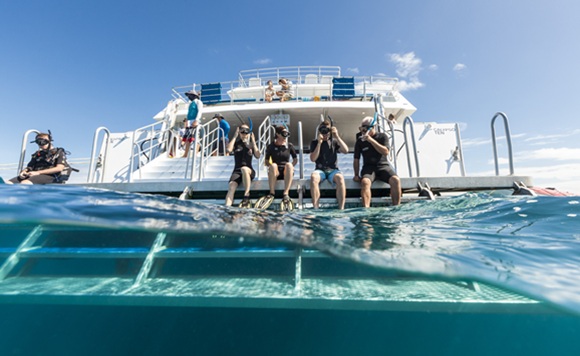
Things visitors can do to help protect the reef
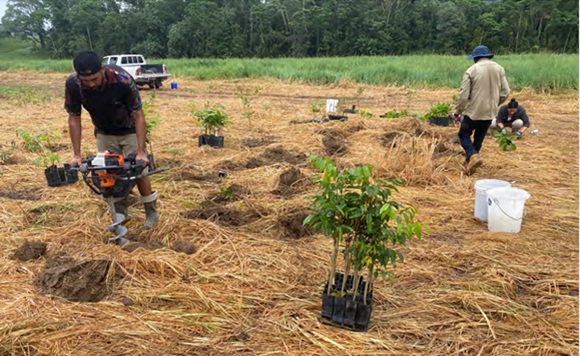
Community groups are restoring riverbanks to help filter water runoff

Martine joined the Wet Tropics Waterways team as a Science Technical Officer in early 2024. She is an environmental scientist and ecologist and has worked on water quality and aquatic ecology projects as a consultant and in private industry for over 20 years. She is using her experience in statistical programming and database development to develop new systems for the Report Card.

Richard has been the Science Technical Officer for Wet Tropics Waterways since 2016. His role involves producing the annual results for the waterway health assessment of the wet tropics region using data from a wide range of sources, to present as scores and grades, as well as developing new indicators to address knowledge and monitoring gaps. He works in collaboration with technical staff at other regional report cards.
Richard has a background in freshwater ecology research projects and environmental assessments with CSIRO, University of Queensland, Queensland Government and as a consultant. For a long time he’s been interested in freshwater aquaculture and continues this interest through farming freshwater crayfish, alongside other farming activities.

Simon has over 30 years’ experience advocating for waterways across academia, government and the private sector. He started out in marine botany with a fascination for seagrass, mangroves and macroalgae, and has gone on to lead major environmental initiatives both in Australia and overseas. He has established report cards in eight countries.
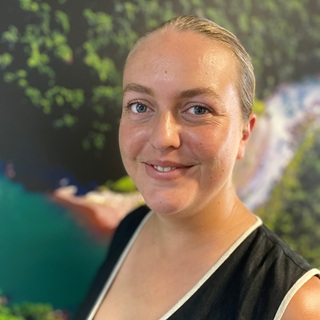
Rowan is a conservation scientist with a background in wildlife science and tropical ecology. She holds a Bachelor of Wildlife Science from the University of Queensland and has recently completed a Master of Tropical Biology and Conservation at James Cook University.
Rowan brings experience in science communication, with a strong interest in connecting people with conservation outcomes. In her role with Wet Tropics Waterways, she supports initiatives that combine scientific knowledge with community outreach to help protect the Wet Tropics and Great Barrier Reef catchments, and to strengthen collaboration between researchers, stakeholders, and the wider community.