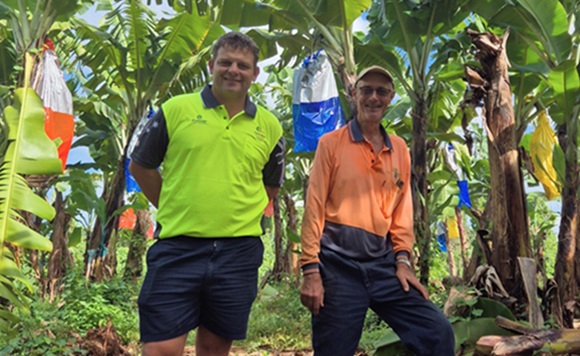
ABC Bananas: Farming for the future.
Banana farmers making land management changes to improve water quality to the Reef

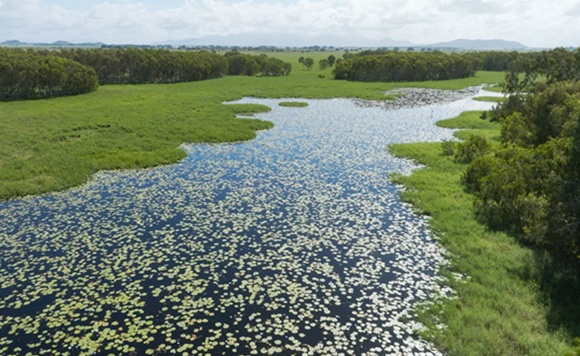
Jacob Cassady looks out over a wetland full of fish and birdlife. There’s a proud look in his eyes because he remembers a time when only tilapia, an introduced fish, was managing to live amongst the tangle of weeds.
“Now we have lots of fish species and bird watchers come here from all over the world, especially when the migratory birds arrive each year,’’ he says.
The 880-hectare cattle station, beside Halifax Bay Wetlands National Park and just one kilometre from the ocean, has diversified into eco-tourism since the wetlands were restored. Work began when Mungalla Station was handed back to traditional owners in the late 1990s and it accelerated when a bund wall, built to create more grazing land in the 1940s, was taken down.
“Seawater could flow back through the wetland,’’ Jacob, who is a Nwaigi Traditional Owner and Mungalla Aboriginal Corporation director, says. “It killed the noxious weeds. We’d been doing ground spraying, aerial spraying and cultural burning but removing the earth wall was the best option.
“A year later we had little to no weed. The following year Bulgaroo was growing there.
“We still have much more to do. With the recent big floods, sediment flushed through the catchment and parts of the wetland closed up again. There has also been an explosion of hymenachne weed.
“But to see the wetlands coming back to life, and fish species returning like barramundi, is really rewarding. We sit beside the Great Barrier Reef Marine Park lagoon and Halifax Bay, so it’s critical that the water going out there is clean – and that doesn’t happen unless the wetlands are functioning and creeks are flowing without sediment build-up and invasive weeds.
Blue carbon initiative
The Nwaigi people’s goal now is to remove the entire bund wall and establish a blue carbon project for the 230-hectare wetland.
“We’ll lose some pasture ground for our cattle but I’m optimistic about the environmental benefits and the economic benefits, hopefully through carbon credits,” Jacob says.
‘Blue carbon’ is carbon stored by oceans and coastal ecosystems including mangroves, wetlands, saltmarshes and seagrass beds. It’s captured within the plants and in the sediments below and, given its storage capabilities, it’s an important part of nature-based solutions to climate change.
The Mungalla Aboriginal Corporation has been working with scientists from CSIRO and James Cook University, and with Birdlife Australia, on the wetland restoration project, and with Greening Australia on the Blue Carbon initiative.
New project looking at all of the Herbert catchment
Jacob is also working with Terrain NRM on the Herbert Integrated Project – a new initiative that’s taking a whole-of-catchment approach to improving the quality of water flowing off the land and, ultimately, to the Reef.
The project’s leader, Fiona Barron, says farmers, industry bodies and other community representatives are working together on its co-design to identify the highest catchment priority projects.
“A lot of great work has already happened in the catchment. Farmers have modified machinery and changed crop management to reduce fertiliser and pesticide use and they’ve changed grazing practices to reduce erosion. Erosion solutions like rock chutes have been combined with revegetation work along waterways, and wetland restoration has also been happening.
“Now we need to move beyond isolated fixes, look at the catchment as a whole and involve everyone with a stake in it to develop solutions that benefit the whole environment and the community too.” The project seeks to further extend benefits though natural capital opportunities and other circular economy initiatives.
The Herbert Integrated Project is funded through the Queensland Government’s Queensland Reef Water Quality Program. Mungalla Station projects have been funded through the Australian Government’s Caring for Country program, Community Action Grants, the Biodiversity Fund and Sea Country grants.
HERBERT FAST FACTS
The Herbert Integrated Project and Fine Scale Watering Monitoring projects are funded through the Queensland Government’s Queensland Reef Water Quality Program.
Banana farmers making land management changes to improve water quality to the Reef
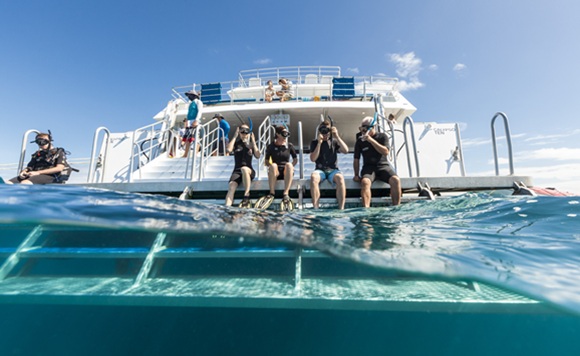
Things visitors can do to help protect the reef
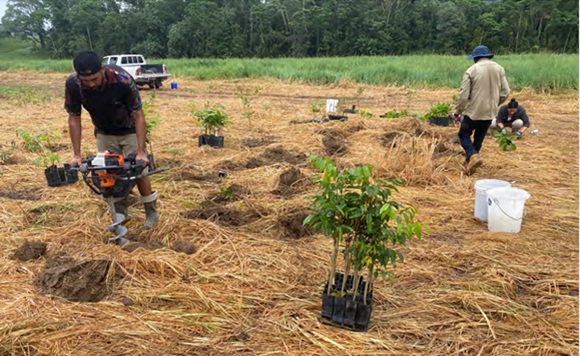
Community groups are restoring riverbanks to help filter water runoff

Martine joined the Wet Tropics Waterways team as a Science Technical Officer in early 2024. She is an environmental scientist and ecologist and has worked on water quality and aquatic ecology projects as a consultant and in private industry for over 20 years. She is using her experience in statistical programming and database development to develop new systems for the Report Card.

Richard has been the Science Technical Officer for Wet Tropics Waterways since 2016. His role involves producing the annual results for the waterway health assessment of the wet tropics region using data from a wide range of sources, to present as scores and grades, as well as developing new indicators to address knowledge and monitoring gaps. He works in collaboration with technical staff at other regional report cards.
Richard has a background in freshwater ecology research projects and environmental assessments with CSIRO, University of Queensland, Queensland Government and as a consultant. For a long time he’s been interested in freshwater aquaculture and continues this interest through farming freshwater crayfish, alongside other farming activities.
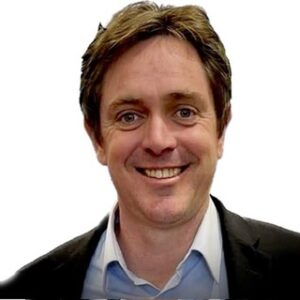
Simon has over 30 years’ experience advocating for waterways across academia, government and the private sector. He started out in marine botany with a fascination for seagrass, mangroves and macroalgae, and has gone on to lead major environmental initiatives both in Australia and overseas. He has established report cards in eight countries.
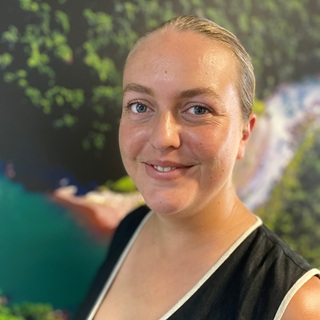
Rowan is a conservation scientist with a background in wildlife science and tropical ecology. She holds a Bachelor of Wildlife Science from the University of Queensland and has recently completed a Master of Tropical Biology and Conservation at James Cook University.
Rowan brings experience in science communication, with a strong interest in connecting people with conservation outcomes. In her role with Wet Tropics Waterways, she supports initiatives that combine scientific knowledge with community outreach to help protect the Wet Tropics and Great Barrier Reef catchments, and to strengthen collaboration between researchers, stakeholders, and the wider community.